What is Śavāsana? Tracing the History of "Corpse Pose"
Jun 29, 2026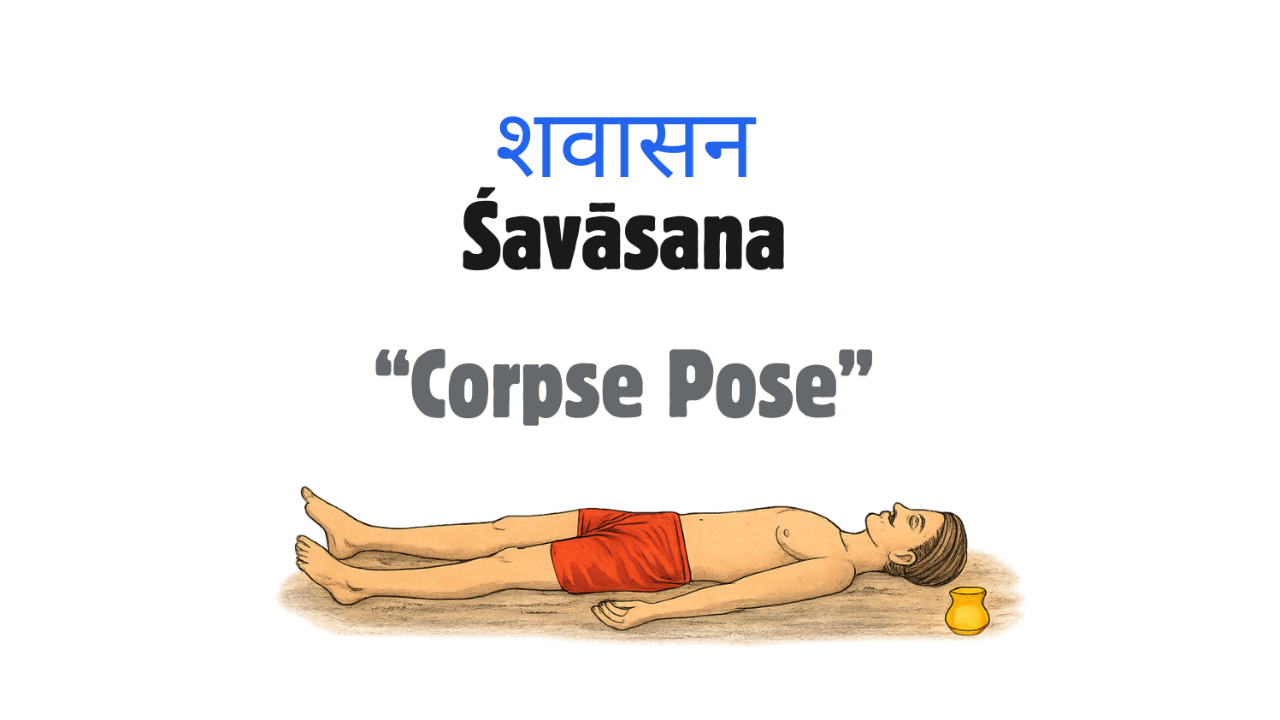
What is Śavāsana?
Known in the modern yoga world as "corpse pose," a ritual signoff to any contemporary yoga class, the roots of Śavāsana are lesser-known.
Its origins reach deep into Tantric layayoga—the Yoga of Dissolution—where lying like a corpse was a secret method (saṃketa) for dissolving the mind into the absolute.
Modern + Relaxation
Today Śavāsana is most often taught as a closing relaxation posture—a chance to rest the body and settle the mind after practice.
Tantric + Esoteric
Traditionally, lying like a corpse belonged to a much older and stranger lineage: a secret technique for dissolving the mind into its object of meditation.
How to say Śavāsana
Sanskrit: शवासन śavāsana
A compound of two Sanskrit words:
- शव śava—"corpse" (ś = English sh)
- आसन āsana—"posture, seat"
Say "shah-VAH-sana"—not "sah-VAH-sana." The romanization savasana is a common error which leads to mispronunciation. The initial ś is a palatal sibilant, similar to the English sh in "show."
Layayoga: The Yoga of Dissolution
Before Śavāsana was ever a yogic posture (āsana), lying like a corpse belonged to layayoga—the complete dissolution (laya) of the mind into its object of meditation.
Śiva himself is said to have transmitted secret methods (saṃketa) for achieving this state:
- Gazing at the big toe
- Lying like a corpse
- Inner sound (nāda)
These saṃketas are similar to meditation practices taught in Śaiva texts such as the Vijñānabhairava—said to result in the dissolution of the mind through effortless absorption.
Lying Like a Corpse
One of the oldest surviving Haṭhayoga texts, the Dattātreyayogaśāstra (13th century), preserves the technique as one of the fifteen million saṃketas taught by Ādinātha (i.e. Śiva):
[Another] excellent [esoteric technique] is dissolving [the mind] into the big toe of one's right foot. And lying on the ground like a supine corpse is said to be the best of the best. (24)
If one practices [these techniques] in a place free from people while relaxed, one will achieve success. (25)
—Dattātreyayogaśāstra 24–25, trans. James Mallinson
First Taught as an Āsana
Svātmārāma's 15th-century Haṭhapradīpikā first codified śavāsana among the canonical āsanas of haṭhayoga—the only supine posture among its fifteen.
uttānaśavavad bhūmau śayanaṃ tu śavāsanam |
sarvāsanaśrāntiharaṃ cittaviśrāntisādhanam ||Lying on the ground like a corpse with its face up is the corpse posture. It removes fatigue [caused by practising] any āsana and calms the mind.
—Haṭhapradīpikā 1.32, trans. Mallinson, Birch, et al.
Mṛtāsana: "Dead Pose"
Sanskrit: मृतासन mṛtāsana
The eighteenth-century Gheraṇḍasaṃhitā teaches it among its thirty-two postures, only it appears under a variant name: Mṛtāsana, the "Dead Pose."
Mṛta (मृत) means "dead"—a near-synonym for śava. Both names evoke the same image: the yogin lying utterly still, as if dead to the world.
The Modern Transmission
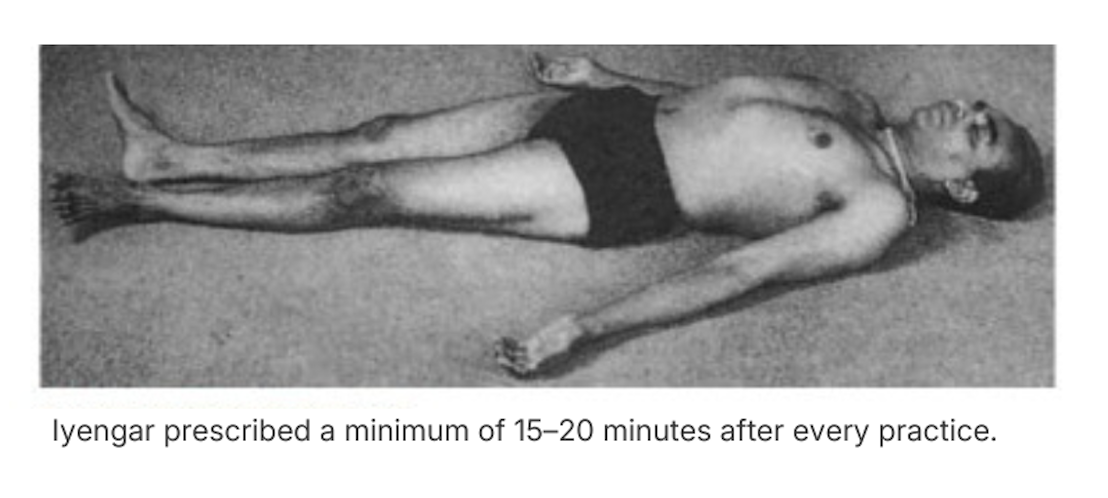
B.K.S. Iyengar's landmark book Light on Yoga (1966) helped bring śavāsana—presented as both Śavāsana and Mṛtāsana—to a global audience.
"Śava or Mṛta means a corpse. In this āsana the object is to imitate a corpse. Once life has departed, the body remains still and no movements are possible. By remaining motionless for some time and keeping the mind still while you are fully conscious, you learn to relax. This conscious relaxation invigorates and refreshes both body and mind. But it is much harder to keep the mind than the body still. Therefore, this apparently easy posture is one of the most difficult to master."
—B.K.S. Iyengar, Light on Yoga (1966), p. 422
"The stresses of modern civilisation are a strain on the nerves for which Śavāsana is the best antidote."
—B.K.S. Iyengar, Light on Yoga (1966), p. 423. Iyengar prescribed a minimum of 15–20 minutes after every practice.
From Saṃketa to Āsana to Stress Relief
- Dattātreyayogaśāstra (13th c.): dissolution of the mind
- Haṭhapradīpikā (15th c.): removes fatigue; calms the mind
- Light on Yoga (20th c.): relaxes mind/body; removes stress
Across nearly a millennium—from the Dattātreyayogaśāstra to Light on Yoga, from medieval Tantra to modern transnational yoga—the technique has transformed across texts and traditions, yet its fundamental promise remains unchanged:
Stillness of body as the gateway to stillness of mind.
Want to go deeper?
Bibliography
- Iyengar, B.K.S. 1966. Light on Yoga.
- Mallinson, James. 2023. Trans. and ed. Dattātreyayogaśāstra: Dattātreya's Discourse on Yoga.
- Mallinson, James and Mark Singleton. 2017. Roots of Yoga.
- Mallinson, Birch, et al. Haṭhapradīpikā. Trans. and ed. hathapradipika.online