Hatha Yoga vs. haṭhayoga: What is the Difference?
Aug 05, 2026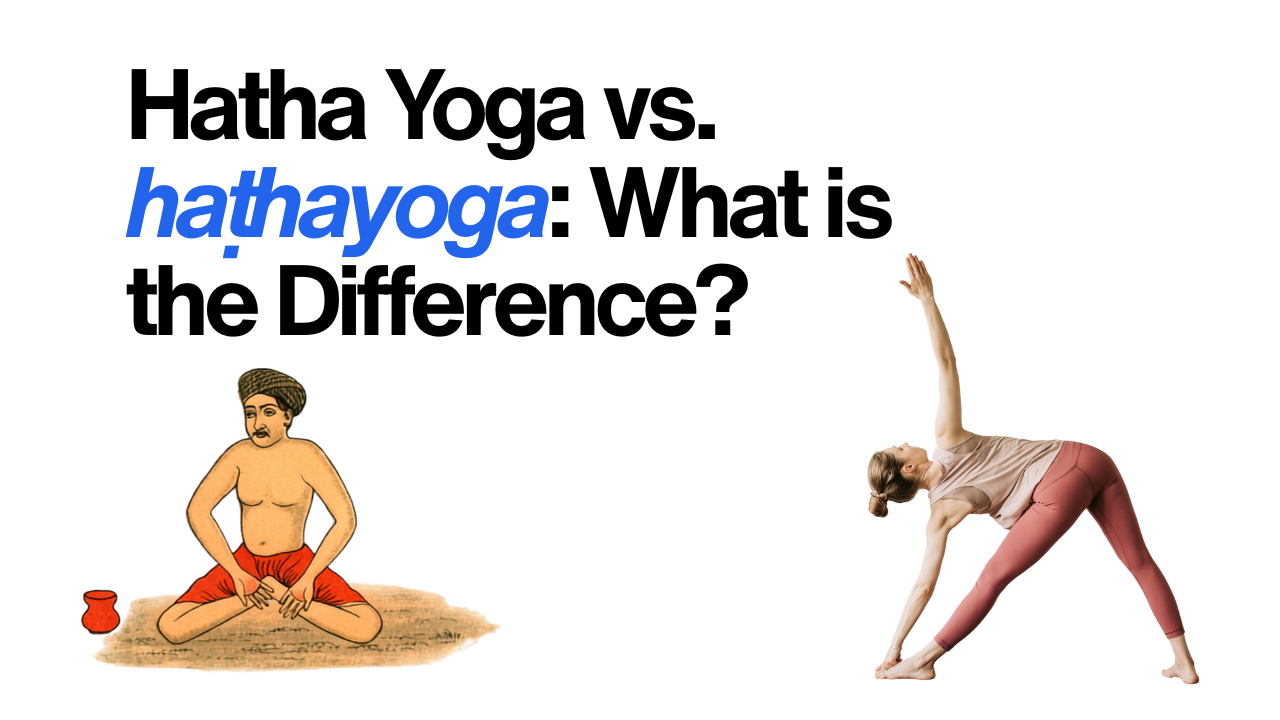
What is the difference between Hatha Yoga and haṭhayoga?
You've probably taken a Hatha Yoga class. But have you ever practiced haṭhayoga? What are the key differences between modern Hatha and premodern haṭhayoga traditions?
Slow + Relaxing
Today “Hatha Yoga” is often used as a typology of postural yoga practice often emphasizing slower, gentler, and longer holds of āsanas.
Ascetic + Soteriological
Traditionally haṭhayoga referred to a “forceful” set of psycho-physical methods aimed at raising vital energies in the body and attaining mokṣa.
How do you say haṭha? What does it mean?
Sanskrit: हठ haṭha
haṭha (HUTT-ha)—the ṭh is an aspirated retroflex consonant, pronounced with the tongue curling back to the roof of the mouth, and an extra breath. Not the soft "th" in "bath." Not the hard “th” in “these.”
A few things most people don't know:
- The Sanskrit root haṭh means "force" or "will." The compound haṭhayoga means either "the forceful yoga [practice]" or "[the state of] yoga achieved by means of force."
- In medieval sources, the force isn't about muscular effort or a challenging practice. According to Birch (2011), haṭha refers to the effect of the techniques: the forcible redirection of kuṇḍalinī (latent divine energy), bindu (vital essence), and prāṇa (breath/life force) upward through the body's subtle channels.

Union of the sun + moon?
You have likely heard that ha represents the sun, ṭha the moon, and haṭhayoga is their union—the merging of solar and lunar energies in the body.
This “folk etymology” is commonly found in modern yoga literature. Is there any historical precedent?
Yes. The 11th century Amṛtasiddhi defines yoga as the union of the sun and moon, but doesn’t yet mention the phrase haṭhayoga.
This interpretation first appears in the Yogabīja (c. 14th cent.):
hakāreṇa tu sūryo 'sau ṭhakāreṇendur ucyate |
sūryācandramasor yogād haṭhayogo 'bhidhīyate ||
The sun is known by the syllable ha, and the moon by ṭha. Owing to their union, Haṭhayoga is named thus.
But two caveats from recent scholarship:
- Birch (2011) shows this is a secondary, esoteric gloss—probably adopted to avoid associating practice "with any kind of force or violence."
- When Birch and Mallinson prepared the critical edition of the Yogabīja, they found this verse was a later interpolation—not part of the original text (Ondračka 2023).
The sequence of haṭha
The most influential source text on haṭhayoga, Svātmārāma’s c. 1400 Haṭhapradīpikā, teaches the following:
āsanaṃ kumbhakaṃ citraṃ mudrākhyaṃ karaṇaṃ tathā |
atha nādānusandhānam abhyāsānukramo haṭhe || 1.56Posture, manifold breath retention, the bodily technique called seal, then concentration on the internal sound—this is the sequence of practice in Haṭha.
Notice the progression:
- Āsana—posture is preparatory. The HP teaches 15 postures, including for the first time in a haṭhayoga text, non-seated postures.
- Kumbhaka—breath retention. The forcible suspension of breath to drive prāṇa upward; culminating in total cessation of breath.
- Mudrā—bodily energetic seals (mahāmudrā, khecarīmudrā, vajrolīmudrā, etc.). Techniques for retaining bindu and forcing prāṇa into the suṣumnā.
- Nādānusandhāna—listening inward to the unstruck internal sound. Leads to dissolution of mind and, ultimately, samādhi.
How do Hindu ascetics view haṭhayoga today?
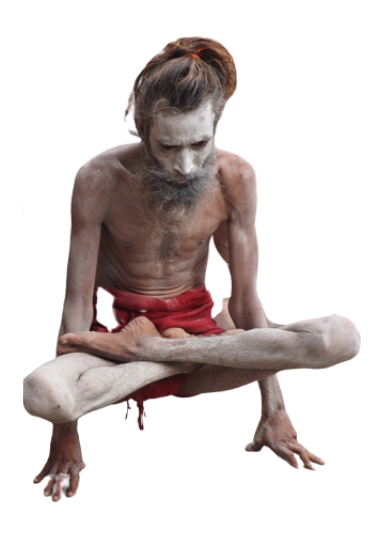
Ethnographer Dr. Daniela Bevilacqua interviewed ~80 contemporary Hindu ascetics—Nāgā Daśanāmīs, Nāth Yogīs, Udāsīns, Vairāgīs—for the SOAS Haṭha Yoga Project.
A few key observations from her study:
- Most sādhus rarely use the phrase "Haṭha Yoga" at all.
- When they do, they understand it as tapasyā (ascetic austerity) or dṛḍh saṅkalp—"firm determination." Not a postural yoga style.
- An ūrdhvabāhu ascetic in Ujjain (arm held raised for 35 years) was identified as a haṭhayogī because he was doing tapasyā.
- A Nāth yogī in Kamakhya said: "Haṭha Yoga means following the rules and behaviours of the sampradāya all life long."
- A Rāmānandī tyāgī: "The exercise of Haṭha Yoga is to stop the flow of prāṇa in iḍā and piṅgalā, to converge it in the suṣumnā. And this is for waking up kuṇḍalinī."
- Only 3 of ~80 gave the sun-moon esoteric definition—all had academic or textual backgrounds (Bevilacqua 2017).
What did Tirumalai Krishnamacharya think?
In his Kannada (and later Tamil) treatise, Yoga Makaranda (1934), Krishnamacharya follows the medieval sources, naming four types of yoga: haṭha, mantra, laya, and rāja—adding his interpretation. Haṭha yoga, he writes, "focusses mainly on descriptions of the methods for doing āsanas," while rāja yoga trains the mind through dhāraṇā and dhyāna, bringing the senses under control at the ajña cakra to perceive the jivātma and paramātma.
Āsana and prāṇāyāma are foundational to both—but he repeatedly marks certain practices as belonging to one path and not the other:
- Haṭha yogis only: bahish kritha dhauti and jihwa dhauti (intestine- and tongue-cleansing kriyas); also mulabandha mudra, khecari mudra, and vajroli mudra.
- Rāja yogis only: viparita karani mudra and tataka mudra are named as belonging to raja yoga rather than hatha.
- Both, but diverging: in janusirsasana, hatha and raja yogis share the same base posture, but the hatha practitioner presses the heel between rectum and genitals while the raja practitioner places it between scrotum and genitals—"the practitioner should learn the difference."
Modern “Hatha Yoga” = Stretching + Relaxation?
In an important 2005 article, Dr. Mark Singleton traces the emphasis on relaxation and stretching to 19–20th century Western proprioceptive therapy traditions absorbed into yoga during the colonial period.
“[T]his discourse of ‘spiritualised’ relaxation in yoga is a relatively new and composite phenomenon. It became part of the credo of ‘export brand’ yoga during the late nineteenth and early twentieth century and is an amalgam of proprioceptive therapies, early humanistic psychology, and a variety of Western esoteric speculations.
In the contemporary yoga world, ‘relaxationism’ draws on the interpretative frameworks offered by New Age religion... This blend of biomedicine, psychology, and esoterica is very generally propagated as ‘wisdom of the East’ and a critical distinction is rarely drawn between modern relaxation techniques and ancient practices.”
haṭha or Hatha?
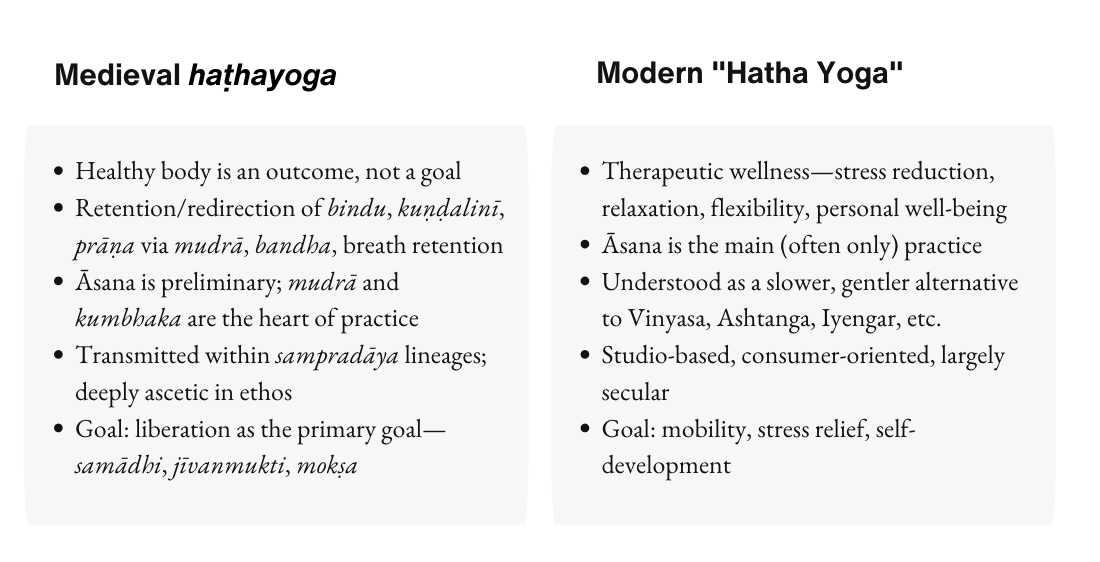
As Singleton observed: modern transnational yoga
"is not the outcome of a direct and unbroken lineage of haṭha yoga… [it] is the result of adaption to new discourses of the body that resulted from India’s encounter with modernity" (2010: 33).
Want to go deeper?
Bibliography
- Bevilacqua, Daniela (2017). "Let the Sādhus Talk." Religions of South Asia 11.2–3: 182–206.
- Birch, Jason (2011). "The Meaning of haṭha in Early Haṭhayoga." JAOS 131.4: 527–554.
- Haṭhapradīpikā of Svātmārāma (2026). Trans. Mallinson, Birch, et al. (hathapradipika.online).
- Krishnamacharya, Tirumalai (1934 [2006]). Yoga Makaranda. Trans. Ranganathan.
- Mallinson, James (2020). "Haṭhayoga's Early History: From Vajrayāna Sexual Restraint to Universal Somatic Soteriology." In The Oxford History of Hinduism.
- Mallinson, James (2025). "What is the Difference between haṭhayoga and Hatha Yoga?" In Yoga Studies in Five Minutes, edited by Theodora Wildcroft and Barbora Sojková, 158–59. Equinox.
- Ondračka, Lubomir. "Haṭhayoga." In Hinduism and Tribal Religions, ed. Long et al. Springer, 2022.
- Singleton, Mark. "Salvation through Relaxation." JCR 20.3 (2005): 289–304.
👉 Click the link to download the articles today.